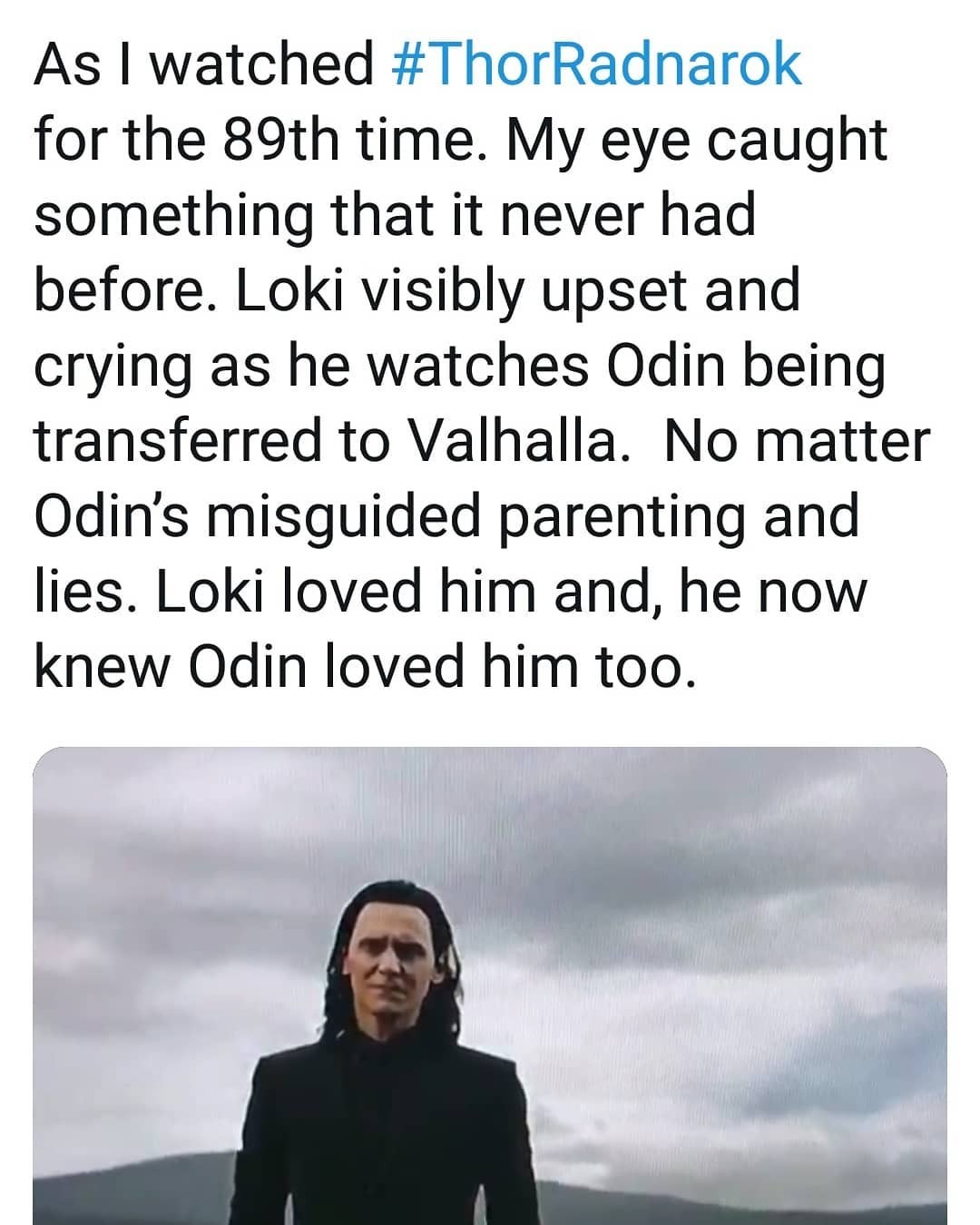
I belatedly caught that too, in the wide shot. You can see both brothers, but Loki’s chest is heaving and Thor’s is not. That made me obsessively rewind.
Loki’s as close to crying, proper heaving sobs, as you’ll ever see. He never breaks, because he’s Loki. But yeah. His entire body’s grieving. He’ll never get a chance to go back and feel Odin’s love as it was meant to be.
Unless A4 gets really timey wimey.
Well, guess I’ll be spending this day in tears. Thanks a lot 😭😭😭😭
Also i guess that’s how Tom was playing this scene, and that’s why at the Comic Con he said that line about “realising the love of his father”.
Mhh, I already saw it when I watched the movie for the first time but I still don’t consider this as a real grief for the beloved father. I look at it from a psychological perspective. It’s a normal reaction to cry when you’re coming out of an extremely emotional situation where you found out another family secret, feel guilty cause you did something cruel and became something you never really wanted because then you are no different from the one person you rejected because of that. And suddenly this person seemed to show a kind of affection, something you had wished to get all your life. You don’t know if you’re surprised, deeply touched or just misguided. It’s a common reaction to feel something towards your „abuser“, it’s called Stockholm syndrome.
I don’t consider Loki’s tears as a grief over losing his father. But that’s of course just my point of view.
I’ve never noticed this before! :’O Honestly I’m kind of in between the two ideas, from the way Odin and Loki interacted in Thor 2011, I can kinda see Loki being like, despite everything they still loved each other, but Odin from the Dark World treated Loki like the absolute worst, so I think that would lend itself towards what @motherhela said.
Either way, tho, Loki crying is the worst feeling. 😢
As moving as this is, it’s really confusing when you consider the last time Odin saw Loki.
I’m going to agree with @motherhela. Loki is visibly upset because it’s an upsetting situation.
Loki was just recently ripped away from Asgard…after seeing (and being threatened by) Thor for the first time in years. He spent 30 minutes falling. Then he saw his dad again for the first time in years, only to find out that his dad is dying. Then Loki found out that he has a sister and that Asgard is on the brink of destruction. On top of all that, his cover was blown. So, he knew it would only be a matter of time before Thanos found him, which is probably why he was considering staying on Sakaar. I’d be crying too. Or vomiting. Or both.
As far as I’m concerned Odin’s “evidence of love” for Loki was too little, too late, and frankly only served to make Loki more conflicted (been there) by feeling obligated to return affection to someone who kept him at arm’s length at best for most of his life. Odin used Loki as a convenient chess piece in his extravagantly corrupt game of imperialist conquest. There is no better way to break a people than to take one of their own and assimilate that person into the dominant culture, giving them a case of, once they learn their true heritage, internalized racism that there is no evidence Loki ever got over.
Let’s also remember it’s in the context of Odin conveniently expiring right after telling his sons of yet another problem he swept under the rug and let fester, for them to later clean up with, among other things, their total lack of a sense of personal boundaries from Odin and from each other; Thor’s learned narcissism; Loki’s learned jealousy and paranoia; and a sibling who literally wants to kill them and destroy their world, specifically because she was fed the rhetoric of conquest, and then punished for acting on it too autonomously.
Odin does not deserve forgiveness. I am glad for whatever closure Thor and Loki obtained, but it was not with their father’s help.
Loki is crying here in good part because he KNOWS he will NEVER obtain true closure with Odin. He didn’t get a chance to say a word. And that’s agonizing for Loki, who communicates both intent and emotion with exceptionally nuanced linguistic routes, far more than with action.
And Thor, how Thor mistreats Loki (and vice versa) in the wake of Odin’s death, is ripe evidence of this. Odin’s spirit has barely dissipated before Thor is wrongly blaming Loki for his death: because it’s far less painful a case of cognitive dissonance to blame the “bad” little brother than the patriarch who was “all-knowing and wise” and metonymic of your entire home, society, and values (values that in crisis you will cling too all the more blindly and tenaciously).
//Absolutely not. I don’t think Thor consciously realizes it at all, and I doubt he ever will. It can be difficult for the child of abuse in any form to acknowledge as an adult that the parent figure they (and in this case their whole culture) admired (even in this case revered) was toxic. This often leads to misplaced feelings of shame, vulnerability, and guilt. Especially in Asgard, which has a no-tolerance policy for the “weakness” of mental illness (and no modern concept thereof). You literally battle away your feelings there; the lifespans are so long that certain social customs remain antiquated.
When I used to volunteer as a mentor-tutor for underprivileged children, and when I took developmental psychology courses, one of the most striking things I noticed was that children of abuse of varying forms, physical, sexual, or emotional/psychological, are often tremendously DEFENSIVE of the abusing parent. For instance, the children of parents who use corporal punishment are often, as adults, the people who fly into a genuine fury at child advocates who say that spanking is abusive.
For Thor to acknowledge Odin abused him, he must acknowledge that every value and principle for which he stands, that derived from Odin–even parts of Thor’s personality–were faulty. This would mean the exhausting work of reinventing HIMSELF, too.
This, I think, is exactly why Thor still refuses to fully acknowledge that Loki was also abused, and that Odin’s abuse is partially responsible for Loki’s wildly misguided behavior. Even as of Ragnarok, Thor sees Loki’s mistakes as 100% of Loki’s own volition, and while LOKI ALONE is to blame for Loki’s actions, it makes a great deal of difference when you acknowledge that Odin’s messed up parenting originates a lot of Thor and Loki’s misunderstandings, as well as Loki’s desperate attempt to emulate and please their father.
It’s, cognitively and emotionally speaking, easier to blame Loki, because Loki has always been something of a misfit in the family structure. Loki also has less emotional power over Thor as a sibling than Odin has as a father, both personal and cultural. It’s a horrible irony that Odin’s abuse of Loki is perpetuated by Thor’s unwillingness to see that abuse, IN GOOD PART BECAUSE ODIN HAS ALWAYS KEPT THOR SO CLOSELY IN ODIN’S SHADOW, AND DENIED THOR THE OPPORTUNITY TO THINK FOR HIMSELF. One of the best examples of this is in The Dark World, when Odin treats Jane Foster, Thor’s beloved, like a literal animal, and earlier, tells him he should marry Sif instead.
This only changes SLIGHTLY near the end of Ragnarok, with the “what are you, Thor, God of Hammers?” speech.
It’s all very sad. I wish Thor had been able to say, “You know, I loved our father, but he was fucked up, and SOME stuff wasn’t actually your fault” to Loki before Loki died. I thought for sure he would in The Dark World, when Odin literally ordered him KILLED for treason, but Thor remains way more willing to forgive Odin because Odin has Thor in an almost Stockholm Syndrome deadlock, even post-mortem.
Literally the only time Odin ever let Thor do what Thor wanted was when Odin was actually Loki in disguise.
Thor and Odin’s relationship is every bit as abusive as Odin and Loki’s. The thing is, Odin treated Thor and Loki differently and therefore distorted their self-image in different ways. Ultimately, he ensured that both of them were entirely emotionally dependent upon him as the “all-knowing” father figure. I’ve already extensively covered how Odin twisted Loki’s self-image, so I’ll focus, as you request, on Odin and Thor.
Odin, who is a classic Narcissist, turned Thor into a borderline Narcissist and something of a charming bully, who in turn (unwittingly, I believe) perpetuated Odin’s style of abuse on Loki (and others). Thankfully, Thor’s character development has led Thor away from these tendencies (with notable regression in Ragnarok, which I still find kind of disturbing, since the actor and director seem to have felt the portrayal held more integrity to the character ), as well as, I believe, Thor’s innate capacity for goodness, and his earnest desire to champion underdogs.
But Odin remained a Narcissist to the end, and made it as hard as possible for Thor to break that cycle.
Odin made Thor to be a complete extension of himself, to the point that film critics have called out Thor as a protagonist who is quite “reactionary” (that is, someone who doesn’t cause plot, but rather, reacts to things that happen to him, making him somewhat wooden as a character of focus in his first two films, and even offering Loki the opportunity to steal the show multiple times by being, comparatively, plot-driving). Odin repeatedly told Thor and Loki that both could contend fairly for the Throne of Asgard, while full well knowing that his eldest and legitimate heir would become the next king. In doing so he emotionally isolated the brothers from each other, making each more dependent on HIM and on HIS idea of “worthiness” (using Mjolnir greatly to this end) and with repeated microaggressions toward Loki, made it clear that he favored Thor (in large part because Thor naturally held traits that make a person a “good” Asgardian: physically active, forthright and plain-spoken, masculine, etc).
Thusly isolated, Thor became the person we see in Thor 1 and, partially, in Ragnarok: convinced that he was infallible, that with enough charm and swagger and cajoling he can get whatever he wants, that people SHOULD give him whatever he wants. He has no sense of boundaries and he takes even dear lifelong friends’ welfare for granted. What Odin did to Thor is in fact the pivotal element of Thor’s growth from a spoiled arrogant bully to an earnest, caring champion of justice. It’s the rock-bottom starting point for Thor, morally speaking.
And while I’m at it, things like this are precisely why I love Thor as much as I love Loki, and see them as a matched set. They are complementary and, at their best, symbiotic, and Thor (written correctly) is every bit as much an interesting, flawed character learning to atone as Loki is. And this is why I don’t know what to say when people accuse me of “stanning” Loki and “hating” Thor. I don’t. I just see them as having DIFFERENT KINDS of flaws, and Thor as, while not ENDING that way, STARTING OUT in a position of greater social advantage (rather like how BLM people say “we aren’t saying all lives don’t matter, we’re drawing attention to this particular case of oppression, and how white people will never have to worry about certain TYPES of hardship”: in this scenario, Thor is the white guy. That doesn’t mean Thor isn’t a wonderful person, or that Thor doesn’t also LEGIT suffer A LOT).
It’s unfortunate that the fandom likes to pit them against each other. Maybe now that Loki has literally died to save Thor’s life, and Thor has made it his remaining goal in life to avenge Loki (and his people), it will become clear what a functioning unit they are.
Addressing comments in the tag: please note that I have said ALL ALONG, SINCE EARLY 2012, that Thor is pardoned by the writers and narrative for acts that equal in moral corruption anything Loki has done, while Loki is unjustly scapegoated and condemned, and that this is A BAD THING.
That’s exactly what I was talking about in this very post when I said:
that Thor is a character with great merit IF written correctly (big condition there, big if)
that while Thor may suffer as often as Loki suffers,Thor still enjoys social advantage compared to Loki, and that people who bristle at this fact remind me of All Lives Matter people who get angry at Black Lives Matter protesters, failing to realize that saying one social group’s oppression does not negate another’s hardship, it just means that that hardship isn’t based in racial, ethnic, or other forms of oppression.
I’m tired of this, folks. I don’t mean to sound testy, but I’ve been saying these things for almost eight years, dedicated to the defense of Loki as a character and as a concept. I only want to do so accurately. I don’t need to lampoon Thor further than he deserves in order for Loki to be given his due dignity. Please read what I say more carefully before critiquing it.
Last time I’m acknowledging comments of this nature at all.
Thor and Odin’s relationship is every bit as abusive as Odin and Loki’s. The thing is, Odin treated Thor and Loki differently and therefore distorted their self-image in different ways. Ultimately, he ensured that both of them were entirely emotionally dependent upon him as the “all-knowing” father figure. I’ve already extensively covered how Odin twisted Loki’s self-image, so I’ll focus, as you request, on Odin and Thor.
Odin, who is a classic Narcissist, turned Thor into a borderline Narcissist and something of a charming bully, who in turn (unwittingly, I believe) perpetuated Odin’s style of abuse on Loki (and others). Thankfully, Thor’s character development has led Thor away from these tendencies (with notable regression in Ragnarok, which I still find kind of disturbing, since the actor and director seem to have felt the portrayal held more integrity to the character ), as well as, I believe, Thor’s innate capacity for goodness, and his earnest desire to champion underdogs.
But Odin remained a Narcissist to the end, and made it as hard as possible for Thor to break that cycle.
Odin made Thor to be a complete extension of himself, to the point that film critics have called out Thor as a protagonist who is quite “reactionary” (that is, someone who doesn’t cause plot, but rather, reacts to things that happen to him, making him somewhat wooden as a character of focus in his first two films, and even offering Loki the opportunity to steal the show multiple times by being, comparatively, plot-driving). Odin repeatedly told Thor and Loki that both could contend fairly for the Throne of Asgard, while full well knowing that his eldest and legitimate heir would become the next king. In doing so he emotionally isolated the brothers from each other, making each more dependent on HIM and on HIS idea of “worthiness” (using Mjolnir greatly to this end) and with repeated microaggressions toward Loki, made it clear that he favored Thor (in large part because Thor naturally held traits that make a person a “good” Asgardian: physically active, forthright and plain-spoken, masculine, etc).
Thusly isolated, Thor became the person we see in Thor 1 and, partially, in Ragnarok: convinced that he was infallible, that with enough charm and swagger and cajoling he can get whatever he wants, that people SHOULD give him whatever he wants. He has no sense of boundaries and he takes even dear lifelong friends’ welfare for granted. What Odin did to Thor is in fact the pivotal element of Thor’s growth from a spoiled arrogant bully to an earnest, caring champion of justice. It’s the rock-bottom starting point for Thor, morally speaking.
And while I’m at it, things like this are precisely why I love Thor as much as I love Loki, and see them as a matched set. They are complementary and, at their best, symbiotic, and Thor (written correctly) is every bit as much an interesting, flawed character learning to atone as Loki is. And this is why I don’t know what to say when people accuse me of “stanning” Loki and “hating” Thor. I don’t. I just see them as having DIFFERENT KINDS of flaws, and Thor as, while not ENDING that way, STARTING OUT in a position of greater social advantage (rather like how BLM people say “we aren’t saying all lives don’t matter, we’re drawing attention to this particular case of oppression, and how white people will never have to worry about certain TYPES of hardship”: in this scenario, Thor is the white guy. That doesn’t mean Thor isn’t a wonderful person, or that Thor doesn’t also LEGIT suffer A LOT).
It’s unfortunate that the fandom likes to pit them against each other. Maybe now that Loki has literally died to save Thor’s life, and Thor has made it his remaining goal in life to avenge Loki (and his people), it will become clear what a functioning unit they are.
what seemingly insignificant memories stuck with your character?
Most of Loki’s banal, everyday memories are connected to Thor, because they bunked together as children and were treated as a matched pair, with Loki the “grooming pony” for Thor the champion racehorse, ever at his side to buffer, protect, and “healthily” compete with Thor. So it’ll be things like, how Thor’s hair looked on a sunny day, or how terrible Thor’s armor smelled after sparring practice. Possibly one important memory of Loki’s unique to MY Loki muse is one banquet that would have turned out disastrous for Thor–who, in my headcanons, is mildly learning disabled (dyslexic and attention-deficient)–had Loki not been hiding under the banquet table feeding him lines from a passage of epic poetry about Odin that Thor was meant to recite to the entire table of diplomatic guests. I love this headcanon because it shows the backbone of Thor and Loki’s young relationship, to which Thor often later defaults: Loki, concealed in the proverbial woodwork, but hardwired to protect and support his big brother, who enjoys attention and is seen as the infallible golden child (something that carries its own unhealthy, unrealistic pressures).
what does your character pretend or try to care about?
Loki TRIES to care about NOTHING, even pretending this to deceive HIMSELF (Frigga was right, despite the context of telling him he is “perceptive about everyone but himself,” in that Loki has a peculiar blind spot, partly self-preserving and partly self-thwarting, when it comes to inward reflection), but it never gets him far. In fact it’s usually detrimental to his long-range plans, particularly when Thor, Frigga, or even Odin is involved. What Loki does care about? Self-sufficiency, self-worth, intellectual stimulation and growth (despite Ragnarok!Thor’s strange allegations of “stagnating” and “becoming predictable”), keeping a sharp wit, KNOWLEDGE for its OWN sake, SECURITY (often perceived as synonymous with power, which he doesn’t really want nearly as much as he tells himself), HERITAGE, BIRTHRIGHT, and FAMILY. Loki’s ENEMIES like to pretend that he wants the throne and power, but again, the Throne (capital T) to Loki is equivalent both to being seen as a worthy match to Thor (who is also an archetype for Worthiness in general and for Asgardian Worthiness specifically) and to safety/security/stability. Despite being a chaos-monger and an agent of perpetual fluidity/change, Loki is surprisingly attracted to stability (see myths!Loki’s marriage to Sigyn, Goddess of Constancy).
//I DID like it, in the visceral sense, but the longer I thought about it the more I was irked by the unequal efforts to reach that reconciliation. You know? I feel like Loki repeatedly asked Thor throughout Ragnarok to talk to him about their misunderstandings and Odin’s lies being the source of their estrangement, but Thor shut him down petulantly every single time, which is what DIRECTLY led to Loki saying, as they were “escaping” Sakaar together, that “communication has never been our family’s strong suit.” Then he reverts to duplicitous behavior because Thor has convinced him that there is no way to salvage their sibling bond anyway and they should just go their separate ways. Which Thor in turn expects and uses as an excuse to punish Loki, but for all the wrong reasons, not seeing how the ways he shut down Loki’s attempts to compromise and talk contributed to them still having such friction.
It’s such a missed opportunity because by now Loki has been recovering psychologically and physically to the point that he is capable of joking about his trauma, and he has no pressing need to rule Asgard (or anywhere else) except as a self-protection policy. He is basically a neutral, even benign, agent now, with all that hostile attribution bias I’ve talked about before (perceiving everything as more unkind and threatening than it really is, a product of PTSD) diminished. It’s the perfect moment for Thor to lay his grievances before Loki and for Loki to respond rationally and sensitively. But (and STAY WITH ME HERE, I do NOT mean this to sound like “Thor-bashing”) Thor doesn’t take that opportunity.
Why? I think it’s because Thor hasn’t had Loki (or Frigga, or Sif, or Jane), all interestingly feminine-coded forces, around to check his fallback coping behaviors for tragedy (anger, resentment, self-entitlement, arrogance). So oddly enough in Ragnarok, when Loki is on his best behavior, Thor is on his worst. Thor has hit the rock bottom Loki hit two films ago, and, as a character, has regressed to the EXACT behavior he exhibited before falling to Earth in Thor 1. But Thor has no self-reflection whatsoever. He externalizes his hurt as impulsive action and reckless optimism (”It’ll all turn out fine” / “I make grave mistakes all the time!”) which come across initially as endearing teddy-bear quirks but are actually pretty destructive.
So he can’t see his PARTIAL culpability in all this. And that’s all Loki really wants at this point. For Thor to SHARE the blame, and say, “yeah, that was a dick move, sorry, brother,” so they can move forward.
Thor fails this test miserably, as the electrocution with the punishment disc and all the nonsense about Loki being the one to “never change” shows, so what does Loki do?
Loki gives up.
Loki resigns himself.
Loki realizes that if Thor has regressed to an old role, so must Loki. Loki rushes to Thor’s aid, and plays the role of quirky vain Trickster, and stands again, if not in Thor’s shadow, then in a murky in-between space where there’s neither sun nor shade.
Yes, they have peace, and yes Loki has accepted Thor by the end of Ragnarok.
But it’s not acceptance because he’s proud of his brother’s “growth” as a king.
It’s acceptance because Loki has no family or friends left aside Thor, Loki knows Thor cannot even function without Loki, so Loki, a survivor, goes into survival mode. And on some level, because Loki loves Thor dearly.
I don’t think Taika Waititi et al even intended this reconciliation to be so bittersweet; I think they believe this was a wonderful tale of redemption and reunion. But for me, analyzing the whole narrative, it feels very much like a victory at too steep a cost.
But then again, maybe “satisfaction is not in my nature.” 😉 And maybe that’s a good thing.
If you look at the character development for Thor as a character he was not Thor at all. Closest you get is Thor 1 Thor
YES. THAT’S EXACTLY HOW I FELT!!!! In fact I felt that both the strength and th weakness of Thor and Loki’s relationship in Ragnarok was that it was STATIC from how it was when they were young.
Loki is once again the diligent clever sibling who flanks the obnoxious impulsive sibling, the one everyone thinks is more appealing, for whom things always “just seem to work out.” It’s Jotunheim all over again.
All of the same flaws and attributes in them both. Loki was colder and calmer and more practical, like in Thor 1. Thor was charming and warm but also brash and obnoxious and petulant and reactive and temperamental and oblivious to the emotional needs of others (his single apology to Hulk for saying something extremely cutting to Hulk, that “earth doesn’t want you,” is not enough for me to redeem that).
He keeps saying “That’s what heroes do,” and I’m like Thor! You’re being a piss-poor “hero” right now! What happened to everything that Jane and Frigga and even Odin taught you???? About humility???? And reflection before you speak or act????
//Terrified. He’s learned since witnessing firsthand the damage his negligence did to Loki–with some coaxing from Frigga in deleted The Dark World scenes, I might add–and since watching the spiraling unraveling of his entire family’s dynamic in good part due to his arrogance with the Frost Giants, that his power is a doubled edged sword. There are several points in his narrative to date that demonstrate his fear.
In Avengers Assemble, after being deployed from the Helicarrier in Hulk’s cage by Loki, there is a moment, when he recovers Mjolnir, in which he clenches his fist and refrains from lifting it. To me this was a cinematically economical way of showing that Thor doubts his own worthiness as a future King of Asgard, and that’s inextricably tied to the fact that he’s not capable of reaching and reasoning with Loki. This moment begins his narrative turn to being unwilling to inherit the throne from Odin, in The Dark World.
And indeed, in The Dark World, Thor forsakes the throne after Loki’s death because he believes himself unfit for rule–”I would rather be a good man than a great king,” which implies that having the power of the Allfather would make him corrupt, and lead him to arrogance and abuse of his powers.
When we see that his fear of abusing power as a ruler is specific to his fear of becoming a berserker is in Age of Ultron, when Scarlet Witch infects his mind and causes him to hallucinate about all of Asgard, including a blind Heimdall, being trapped in Hel in an eternal state of debauchery. Heimdall specifically tells Thor that he is a “destroyer” and their fate is Thor’s fault, and Thor is encapsulated in uncontrollable, destructive lightning bolts. Originally, as we’ve seen in background shots, Loki was meant to have a prominent role in that scene (fear that Loki’s presence would overpower Ultron’s as an antagonist allegedly led to cutting Loki from the film altogether). In the cut scene, we are told, Hiddleston and Hemsworth filmed Thor following Loki, who was sneaking out of the room in Hel, and Loki and Thor talking, about some grave subject or another. I can only imagine this had to do with Thor asking Loki, who has known him best and longest, to confirm or deny that all he is is a berserker. Tragically without the scene we have no idea whether Loki confirmed or denied it; I would imagine, given that it’s a nightmare and Thor is still grieving Loki’s death at this point, that Loki confirms it.
Loki is in the most peculiar way Thor’s conscience; he always has been, but he still is, not because Loki extensively talks Thor down from tantrums or counsels him anymore, like he did in their youth, but because Loki is proof of things falling apart. Loki is Thor’s failure. He is evidence of the damage Thor did by taking people smaller and weaker and less privileged than himself for granted, arrogance that is inextricably tied with his bad temper and potential to be a berserker. Thor and Loki have reached a tenuous peace since The Dark World, one that appears to hold fast even after Thor has discovered that Loki has been alive and disguised as their father for four years. But in a way, exposure to his very changed little brother–without them sitting down and having a single damn conversation about what Loki suffered while with Thanos and WHY that changed Loki so drastically–is going to only cause Thor heartache because while a part of him wants to blame Loki for the way their family has fallen apart, Thor also knows much of the blame falls on his own shoulders. What has happened to Loki is confirmation of Thor’s worst fears, because he can no longer trust his kid brother and best friend. He lacks that foundation now. And his own character flaws are to blame.
So yes. Terrified. And very anxious to disprove it. I hope he succeeds, because Thor is a wonderfully flawed protagonist and I want to see him grow.
Most of the people that I know view this scene as a cop=out exclusion of Loki in a nightmare that, since it’s Thor, would surely feature his haunted and hauntING little brother pivotally.
And I agree. But that doesn’t mean that Heimdall’s presence in the nightmare, or the things he says, aren’t CRUCIAL to understanding Thor. In fact, I think Thor was one of the only characters who wasn’t desperately off-course in Age of Ultron, because of this very scene.
Thor is desperate to atone for his youth. He is still ill-equipped to do so, still proud and impulsive and temperamental and indelicate, but he is TRYING. He has no idea how his family could so quickly fall to cinders: his mother dead, his father old and ailing in wisdom and flirting with tyranny, his baby brother run mad for revenge over wrongdoings Thor still considers to be “imagined slights.” All that he knows is somehow, his arrogance and warmongering contributed to the dissolution both of his nuclear family and the safety of his homeland. So what does Thor do? He searches for ways to prevent further damage. But what was Thor born to be? A Thunder God!!!! An Elite Warrior!!! Sometimes, even, a berserker: an uncontrollable agent of rage and destruction.
Thor fears that he is unworthy. If you are raised from day one to be the chosen, elite, golden hope of an entire civilization, the pressure will make you at intervals deeply self-confident and deeply insecure. Add to that the truth of his abilities as an inflicter of damage–both literally, as a god of battle, and metaphorically, as a reckless spoiled child who broke his brother’s heart, and (in Thor’s mind) let his mother AND brother–YOUNGER brother, whom he was sworn to protect–die. Imagine the fear that would produce, of causing ruination, despite every futile attempt otherwise.
Enter Heimdall, the OMNISCIENT entity, BLIND, to his literal surroundings, and to the figurative future, but STILL CERTAIN that everyone Thor loves, everyone Thor is meant to protect, will DIE, because Thor was busy galavanting on earth with his new buddies the Avengers.
Because THOR has been the one blind.
Heimdall: “Can you not SEE?” (And remember the TDW motifs of Loki with his illusions, claiming “now you see me, brother,” when Thor is willing to acknowledge how much pain Loki is truly suffering, and so on. Thor and blindness is a big recurrent motif).
Thor is TERRIFIED of being CAUGHT OFF GUARD YET AGAIN to problems that are snowballing downhill, accelerating fast, without his knowledge or ability to stop them.
Because Thor is “A DESTROYER.” It’s what he was born to be, in his own eyes. He is not equipped to be nuanced and strategic, in his own eyes. That’s L O K I . Who, Thor believes at this interval, is dead.
Add to all that the fact that a cut scene exists (probably never to be released by Marvel, but it’s confirmed that it exists) in which Thor follows Loki out of the banquet hall in Hel, and corners him, desperate to talk about what he’s just seen and what it could mean, while Asgard burns all around the two brothers. Loki is and always will be indicative of Thor’s coremost self, his childhood memories, and the FIRST PERSON HE WRONGED and indicative of the keystone to the crumbling wall of his family.
This scene is SO IMPORTANT. It shows SO MUCH about Thor’s worst fears and insecurities.
Well the visions Wanda showed them were meant to be their worst fears. We see how shaken they all are after their visions but Thor my big brave baby goes right back to face his fears and risks his life in order to get the answers he needs.
Right, so his worst fear is dying?
No, I don’t think it’s death he fears. It’s confronting what he saw in his vision again- Heimdall calling him a ‘destroyer’ and saying he’s responsible for their deaths and leading them to Hel, and his powers looking out of control. Plus in the version we haven’t seen apparently there’s a burning Asgard so it’s pretty scary stuff for him. Thor left Asgard in what he thought was his father’s capable hands and swore to protect it even when he was away so to then get a hint that all is not right and on top of that things clicking into place with the Infinity Stones and having to deal with the more immediate threat of Ultron, Thor just has a lot of shit to deal with.
O_O holy shit, you blew my mind……I wouldn’t have thought about Asgard in ruins because of how Thor left it. I mean of course with Loki on the throne and shit, but I didn’t think that was his fear, I always thought of his dream fear was like almost a true vision, like you know a glimpse, idk, it felt different than the other fears for some reason
his worst fear sure as hell isn’t dying, in his culture dying a glorious death, as in dying while fighting, like Frigga, is considered an honour, so he’d welcome death if and when it comes…that’s not to say he’d want to die or that he seeks it. Two different things…I don’t fear death but doesn’t mean I WANT to die.
From what I gather from his visions was that he fears his powers and what he’s capable of, him and his hammer have the hability to do good but also to destroy. But I think the vision also showed him what IS happening and what is to come, it set the ground for Ragnarok, with Loki at the throne, though Thor doesn’t know it yet but he saw a hooded figure that looked suspiciously familiar, and Heimdall’s blindness I think is also something that relates to the Ragnarok myth. Also Asgard looking odd and chaotic might make him think he made a bad choice by refusing to rule his realm.
//Thor fears his own potential to destroy. He’s seen what unleashing that capacity in its fullest has done to Loki, who was previously so sane and stable, and Loki along with his parents defined his childhood and the values and virtues that he absorbed therein. Thor has always been relegated to the role of a potentially destructive force, and he knows it; his element is thunder, associated with storms, which can be what? Either A) replenishing, life-giving, providing water and nourishment, or B) harmful, chaotic, dangerous, causing floods and lightning strikes and damaging winds. Thor understands that his temper and his pride can either make him a powerful force for relentless good, a guardian of weaker beings who deserve his protection, or a mad berserker. It all depends on his competence with the power that he wields. As an essentially good person, he is terrified of the notion of becoming a weapon against his loved ones: an UNWORTHY entity, who already could not save his father from senility, his mother from death, or his baby brother from himself.


 ), as well as, I believe, Thor’s innate capacity for goodness, and his earnest desire to champion underdogs.
  icyxmischief