This is just a reminder that regardless of Infinity War I am going nowhere, whether I have to doctor canon to my will or go full AU. If you still love this character and he’s “dead” after the end of April, come here. I’ll still be writing him.
“ … brother, you do not know what good it does me when you accept … that blame is shared between us.”
Loki treads carefully; his words, he knows, touch upon sore terrain, and Thor is still Thor: temperamental until the end.
“Thank you.”
Shared blame, making neither of them the villain in this particular moment. Or in this particular regard. “I would hate for you to unduly carry a burden such as this upon your own shoulders, when you alone are not at fault.” He explains. “I am thankful, then, that it does you good to know that we can share in this moment together, neither of us being the solitary beholder.”
His head bows, in reverence. “Aye, you are welcome.”
Loki gauges Thor just as his brother’s head dips. There is deference and openness. Excellent. Perhaps now is the time to speak words. more difficult than Loki can ever remember.
“ … brother, I. Am about to say something that will concern you, but you must listen to every syllable, without interruption.”
“Sometime … sometime in the future, I know not exactly when… . I will need to go away.”
He cannot bring himself to say “I will leave you.” There is too much chilling permanence in those four words, and Loki, a wordsmith, for whom every letter is a weapon, cannot wield such a killing blow upon the one person who yet believes in his goodness.
“I will need to do things that will seem, to you, to be wrong, and wicked, and hurtful. I will seem to have abandoned all that we have rebuilt. I am asking you to not press me for more knowledge of what I do. And I am asking you for something more difficult still.”
Loki clasps the side of Thor’s head, and Loki pierces Thor with an unwavering, if watery, jade stare.
{ “Trust me.” }
He presses their foreheads together.
Oh, my brother. Mirror of all that I have been and have dreamt of becoming.
My only true kinsman. My conscience, and my courage. My catalyst to greater things. Everything that I am not.
Monster-slayer. Me-slayer.
My jealousy and my drive. My hero and my best friend.
Please look into our childhood and see that I have always loved you, and always will.
Never doubt.
“Trust the one called Liesmith. Wait and know that all that I do is for a greater purpose. Do not believe your eyes or your ears, but believe me.”
“And in time, you will have your answer.”
Thought I may not be here to give it to you, you will have it. You will.
//I DID like it, in the visceral sense, but the longer I thought about it the more I was irked by the unequal efforts to reach that reconciliation. You know? I feel like Loki repeatedly asked Thor throughout Ragnarok to talk to him about their misunderstandings and Odin’s lies being the source of their estrangement, but Thor shut him down petulantly every single time, which is what DIRECTLY led to Loki saying, as they were “escaping” Sakaar together, that “communication has never been our family’s strong suit.” Then he reverts to duplicitous behavior because Thor has convinced him that there is no way to salvage their sibling bond anyway and they should just go their separate ways. Which Thor in turn expects and uses as an excuse to punish Loki, but for all the wrong reasons, not seeing how the ways he shut down Loki’s attempts to compromise and talk contributed to them still having such friction.
It’s such a missed opportunity because by now Loki has been recovering psychologically and physically to the point that he is capable of joking about his trauma, and he has no pressing need to rule Asgard (or anywhere else) except as a self-protection policy. He is basically a neutral, even benign, agent now, with all that hostile attribution bias I’ve talked about before (perceiving everything as more unkind and threatening than it really is, a product of PTSD) diminished. It’s the perfect moment for Thor to lay his grievances before Loki and for Loki to respond rationally and sensitively. But (and STAY WITH ME HERE, I do NOT mean this to sound like “Thor-bashing”) Thor doesn’t take that opportunity.
Why? I think it’s because Thor hasn’t had Loki (or Frigga, or Sif, or Jane), all interestingly feminine-coded forces, around to check his fallback coping behaviors for tragedy (anger, resentment, self-entitlement, arrogance). So oddly enough in Ragnarok, when Loki is on his best behavior, Thor is on his worst. Thor has hit the rock bottom Loki hit two films ago, and, as a character, has regressed to the EXACT behavior he exhibited before falling to Earth in Thor 1. But Thor has no self-reflection whatsoever. He externalizes his hurt as impulsive action and reckless optimism (”It’ll all turn out fine” / “I make grave mistakes all the time!”) which come across initially as endearing teddy-bear quirks but are actually pretty destructive.
So he can’t see his PARTIAL culpability in all this. And that’s all Loki really wants at this point. For Thor to SHARE the blame, and say, “yeah, that was a dick move, sorry, brother,” so they can move forward.
Thor fails this test miserably, as the electrocution with the punishment disc and all the nonsense about Loki being the one to “never change” shows, so what does Loki do?
Loki gives up.
Loki resigns himself.
Loki realizes that if Thor has regressed to an old role, so must Loki. Loki rushes to Thor’s aid, and plays the role of quirky vain Trickster, and stands again, if not in Thor’s shadow, then in a murky in-between space where there’s neither sun nor shade.
Yes, they have peace, and yes Loki has accepted Thor by the end of Ragnarok.
But it’s not acceptance because he’s proud of his brother’s “growth” as a king.
It’s acceptance because Loki has no family or friends left aside Thor, Loki knows Thor cannot even function without Loki, so Loki, a survivor, goes into survival mode. And on some level, because Loki loves Thor dearly.
I don’t think Taika Waititi et al even intended this reconciliation to be so bittersweet; I think they believe this was a wonderful tale of redemption and reunion. But for me, analyzing the whole narrative, it feels very much like a victory at too steep a cost.
But then again, maybe “satisfaction is not in my nature.” 😉 And maybe that’s a good thing.
Might be over analysing, but I think it’s really significant that Loki comes in last to this scene. After so many years of jealousy, resentment and anger, he is finally joining Thor’s side (hopefully for real this time), and is taking his place as Prince of Asgard. He’s finally home.
It’s definitely not an over analysis from my POV! And I’m an art historian so I basically specialize in analyzing the visual 😀
I’m gonna put aside all my concerns with the narrative being unfulfilled in terms of Thor and Loki doing EQUAL work toward reconciling. Instead I’m gonna comment on this purely in a visual way.
So I felt the same way as you when I watched this scene. We were all kind of chomping at the bit, wondering, “where’s Loki, and did he escape the blast since he was way down in the Treasury (where his own life initially unraveled, as another fan pointed out!) to resurrect Surtur?” And we wait and wait as person after person among the refugees joins Thor in his inner circle of court.
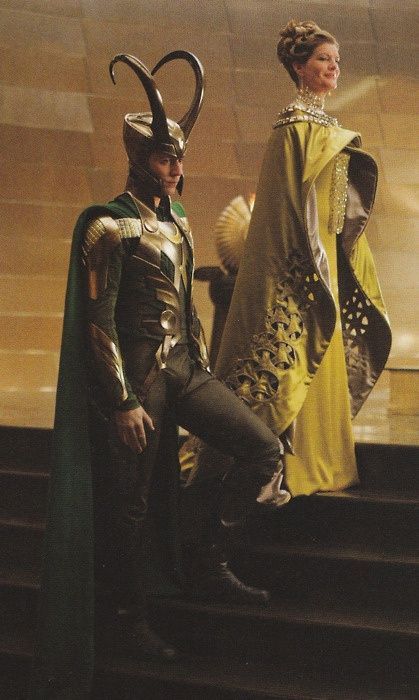
And then finally there is his brother, his mirror opposite, his antithesis and best friend all in one being. Literally standing ON HIS RIGHT HAND, meaning his “right-hand man” or most crucial and influential counsel (and we know that’s Loki to Thor: Loki completes Thor, and vice versa). It’s the same place that Loki, Sif, and Frigga stood in the big golden idyllic coronation scene in Thor 1:
And think of the amazing compositional poignancy of that. They don’t replace the fallen on each side of Thor in the coronation on the refugee ship. They just leave a space and keep the person still left alive among them where he once was. And he stands perhaps a little closer to big brother now, because Frigga’s counsel, and Sif’s, are missing now, and Loki will be needed even more than ever.
This is brought to further fruition in the after-credits scene when Loki and Thor are the ONLY TWO standing looking out at the stars. It directly reflects that they stood shoulder to shoulder before the Coronation that Loki intentionally botched. But this time Loki believes Thor is ready, and does nothing to forestall his brother’s crowning.
They are older and uncertain now, rid of all the silly ceremonial pomp of their helmets and armor, but still the center of each other’s orbit, facing forward at the immediate test or crisis in their future, and on EQUAL footing.
So yes. Of course Loki comes in last. Nobody is more important to Thor than Loki. And it is Loki’s approval, and complicity, that Thor needs in order to feel confident.
After all, when Thor faced Hela, it was not until Loki arrived with the refugee ship from Sakaar that Thor was able to channel his lightning and really bring the fight.
In reality, Thor needs Loki WAY MORE than Loki needs Thor. It’s tragic because even Loki believes the opposite, which is why he gave up after being lectured at and then electrocuted for hours, so he goes to Thor to please him, thinking he has no one else, and no other way to define himself except as a foil to Thor, but Loki has always done better alone than Thor has. Always. Thor backslides into a state of arrogant defensiveness without Loki (we certainly see that in Ragnarok), whereas Loki without Thor lives in relative emotional peace and seems to have psychologically healed; he is able to talk about his traumatic experiences, such as his fall off of the Bifrost Bridge, with humor, rather than dread and shame.
But will Loki always come for Thor, when Thor finds he needs his foundation again?
As this scene at the end of Ragnarok shows us, with Loki trailing into the camera’s view last, yes. Yes, he will. For better or worse. An in-character Loki is, ultimately, not capable of betraying Thor.
Three words. All he had ever searched for. All Odin had never been willing to impart. Miserly even in his last hours, even with Frigga’s gentling spirit calling to him.
And here they are, those three words.
Loki thinks on the man whose good opinion he once fixated upon with such agonies that it festered into a desire for his own ill-gotten kingdom on earth. He thinks on the moment he heard no, and fell, and fell, and f e l l … . shattering his psyche and his body and his spirit so profoundly that even now he has been reassembled differently.
He thinks on the man who held his hand when he was small, and taught him the runes and the histories of the ancients. This man for whom he killed his birthfather, proclaiming himself “Son of Odin.” This man for whom he madly, misguidedly, strove to erase his own bloodline, his own race, in shame, shame, shame.
And did that man rescue him from a frozen rock, or only collar him, and hold his head underwater, while demanding, “swim”?
And does it matter now?
“ … so am I.”
Does he even mean it? Does he even know? But maybe a part of him still wants this man who will alway stand at a distance whom he will never understand to find peace.
Loki is at first so paralyzed by his rage that he cannot muster a syllable.
It isn’t Odin’s presumption to apologize that kindles that rage. It’s his claim that he holds no accountability whatsoever in the debacle that is their family.
“Oh, ‘Allfather,’ I can blame you.”
A brief, mirthless snap of laughter escapes him, a forced cackle so unlike his true, breathy snicker. It is hard and raw and bitter, like everything that he feels for the man that somehow, he mustered the mercy to deposit addled in a retirement home on Midgard.
Not that Thor noticed the restraint that Loki still showed Odin, the remaining scraps of compassion that he could summon for the man who had been an ever-present fixture of his childhood (if only to be distant, and demanding, and never-satisfied, while Frigga salvaged what could be saved of Loki’s mauled self-esteem). No, the moment Odin ascended to Valhalla, Thor summoned an involuntary storm and called the whole affair Loki’s fault.
Old habits, old habits.
“I can blame you for paying me heed only to throw me into inferior relief against my dearest friend and brother, ROBBING US BOTHof the camaraderie we might have better shared! I can blame you for stealing me from my birth home only to prop me up as a convenient backup option should your CONSTANT! GREEDY! Mining of other Realms’ resources and infrastructures come to naught, so you could trade me off with some other artifact to APPEASE the INSURGENT MASSES. You were a POOR king, and a POORER father, and Thor and I BOTH suffered for it, even if he is too blinded by his romanticized memories of you to ever see that.
Give my muse three fears you think they have, and they will order them from what scares them the least to what scares them the most.
Losing Thor. Losing Thor. Losing T h o r .
The very first hellish option petrifies Loki to such an extent that a sheen of clamminess covers his pale skin, and, as his eyes darken, pupils thickening, his mind becomes stuck.
Ever-present, overbearing but warm, presumptuous but affectionate, entitled but loyal. The boisterousness of a storm rolling across endless plains, bringing both the destructive wrath of lightning, and the enrichment of rain.
Maybe Thor is just as dualistic as Loki.
To be bereft of the being who defines him by opposition? Even if it meant Loki were at last free of the self-centered demands and judgments Thor imparts, it would also mean that the Trickster God had cleft his own soul. It would be a melody without its harmony, that profound. It would also be a brother without his brother, the bufferer of his ego, the cleaner of his shit, that simple.
Loki swallows hard. He is eventually conscious, again, of the presence of the Elder God.
THIS IS THE COOLEST THING I HAVE EVER GOTTEN THAT SOMEONE *MADE* ME. WOW. I FEEL SO SPECIAL THAT YOU SPENT SO LONG MAKING THIIIIIS.
EVERYBODY LOOK AT THIS.
I am gonna take a better pic in daylight tomorrow so everyone can see your amazing skills.
//Am I really the only person who thinks that Loki did things intentionally to help Thor survive both his encounter with Hulk, and his final showdown with Hela?
I know he bet against Thor, but hear me out.
–He got Thor angry at him, and out of his depressive sulk, which made Thor determined to win the battle, which fired Thor up once he’d seen his opponent was Hulk, and got him to tap into lightning powers that had no connection to Mjolnir.
–Later, and more importantly, directly after being electrocuted and left behind on Sakaar, Loki mobilizes the revolting gladiators/slaves to fly an enormous spaceship back to Asgard, stands ON A PROJECTING PLATFORM OUT FRONT, AND LOUDLY DECLARES, “YOUR SAVIOR IS HERE!”
WITHIN. THOR’S. EYESHOT AND EARSHOT.
And what immediately happens? THOR REGAINS HIS LIGHTNING POWERS YET AGAIN, AND BUCKS OFF HELA.
Loki listened to Thor, and brought him his hope, his incentive. So often people dismiss Loki’s “your savior is here!” moment as comic relief, as evidence of Loki’s extreme vanity. But I see additional meaning: sure, he had fun doing it, like a true Trickster, but he also made a show on purpose, to catch Thor’s attention, and rile his brother up into prime fighting condition again.
Loki always shows who he loves: but only if you’re paying attention. Because he does it in very convoluted, indirect ways.
:’) Thor thinks that Loki “never changes,” and “refuses to compromise,” and speeches at him about it while electrocuting him, but really, if there’s one unchanging thing about Loki, it’s that he’s got Thor’s back even when it’s directly against Loki’s best interests to be (and we all know how Machiavellian Loki ordinarily is).
And that’s…honestly really…really important. And we could discuss forever whether that shows Loki “redeeming” himself or Loki surrendering himself to the fact that Thor will only ever welcome a reconciliation if Loki yields to Thor’s wishes (so basically, back to square one, to their childhood and youth, with that)….but that’s for another meta entirely.
Tagging @rotaesshinies because this is exactly the sort of theory I could imagine you being on board with.




 icyxmischief